Frequencies, Meditation, and Embracing the Woo
“Raising your frequency” can easily sound like some more woo-woo mumbo jumbo, but the more that I’ve worked on myself, the more I’ve come to really appreciate and understand this concept. It’s become one of the best ways that I can understand myself and my relationships, and see the reasons why I do and do not form connections with others.
If we are to really explore this term and learn more about what it means to get along with others, I believe it all stems from meditation and my understanding of Buddhism.
What is meditation, and what is the point? I first discovered meditation as a teenager while reading a book called To Ride a Silver Broomstick by Silver RavenWolf. (What a name, huh?) The book instructed me to sit quietly, and rather than thinking, to visualize myself as a flowing spigot of water. I can still picture and feel the water flowing over my head and down my body.
Then, once you were part of this mystic waterfall, you were supposed to picture a beam of light coming from above, bathing you in amber or white. Although I knew nothing about meditation or Buddhism at the time, I could feel and picture the exact energy she was talking about.
Later on after college, I discovered another book by Jack Kornfield, A Path With Heart. Meditation was a staple practice for Jack, and he shared different methods at the end of each chapter. This is what finally led me to seek out a formal meditation class and a teacher.
I began taking classes at the Chung Tai Zen Center of Houston, where I was taught meditation in a formal setting and learned how to really develop a personal practice. The main forms of meditation they described started to take hold and develop a deep meaning for me.
First, I was taught Breath Counting. This method allowed me to push aside the noisy internal dialogue I had become so familiar with, and focus entirely on one specific thing—counting numbers. This remains my primary practice to this day, and it is what I still use when suffering from ruminating thoughts or overwhelming emotions.
This practice has given me what Buddhism calls “single-point” awareness, or the ability to focus on a single train of thought with little distraction. The practice itself is simple: you count numbers from 1 to 10, and when your mind wanders, you simply ignore the thought and return to the count. It has given me the ability to remain focused even when I am not meditating, and it has become the primary method I teach my own clients who are looking to learn.
The next valuable skill I was taught by Chung Tai was a 7-round compassion contemplation. Although I have found several simpler forms of compassion meditation that I have come to rely on more heavily throughout the years, the premise remains the same. The idea is to choose people in your life—whether they are people you like, dislike, or have no real opinions on—and send them love and kindness straight from your heart.
You learn to open your emotional understanding to everybody, not just the people you typically associate with or care about. This practice has had a significant impact on my life, and it has done wonders to allow me to connect with clients who are quite different from the family and friends I see day to day. I also credit this practice with allowing me to listen openly to people of all backgrounds and develop a close emotional connection rather quickly.
The feedback I’ve received from clients since then includes things like, “You are a really good listener,” “I just like talking to you,” or “You are easy to talk to.” I believe them, and I feel like many times this is true.
To listen to somebody with an open mind and an open heart is difficult. It is emotionally taxing, and it has taken years to develop. However, just like a leaf turning towards the sun, it happens naturally and without much effort. I wouldn’t call it easy, but maybe it’s a gift I’ve nurtured through both my personal life and my meditation practice. Again, compassion meditation shapes the way I present myself as a person and as a counselor.
The final form of meditation I learned at Chung Tai has always appeared the most mysterious, but in many ways, it has also been the most useful. They call this the “Middle Way Reality Contemplation,” but I refer to it simply as “empty mind” meditation.
The goal of this is what people typically think of when they picture meditation: to exist in time and space with absolutely no thought. Instead, you just watch the world unfold like a passive spectator, neither judging nor commentating on what is happening. In this open, unbiased place, we can view the world as it really is, without relying on the filters of our past trauma and experiences.
One of my first counseling mentors called this the “floating head” phenomenon, and that term has really stuck with me. As I’ve dived deeper into the Internal Family Systems modality, and Parts Work in general, I’ve come to label and understand this as the perspective of the Self—an all-knowing, all-loving part that exists in us all. Remaining in Self, or acting as a passive observer, has become another central state in both my personal practice and my work as a counselor.
Now that we’ve explored what I see as the main skills of my personal meditation practice—concentration, compassion, and the empty mind—what does that have to do with frequency? Well, as these traits have developed within my mind, I have noticed an increased ability to easily connect with others and to be viewed as a compassionate listener. If we look at how the "frequency" of physical sound waves acts, we can understand how this happens even more clearly.
In physics, frequency is defined as “the number of waves that pass a fixed point in a unit of time.” Therefore, if we increase our frequency, it means our wavelength has naturally become shorter.
A lower frequency simply means that the waveform has a longer wavelength. When matching two waves of longer wavelengths together, it can be rather tricky because the waves must sync together perfectly in order to become in tune. However, if one of the wavelengths is much shorter (half the size, for instance), it can more easily fit into the larger wave. It will actually resonate twice just to fit inside of it.
If we use a basic example, a wave with a frequency of 20 Hz has a certain wavelength. A wave with a higher frequency—say, 40 Hz—has a wavelength that is half the size. Because it is smaller, it can fit perfectly inside the larger 20 Hz wave structural window, resonating twice to create harmony.
Now imagine this as the frequency gets higher and the wavelength gets smaller and smaller. A smaller wave can fit 3 times, 4 times, or 8 times into that larger baseline wave, effortlessly finding a way to harmonize.
The larger wave will certainly notice this harmony, describing the high-frequency wave as “easy to get along with.” However, the inverse is not necessarily true; the higher-frequency wave does not automatically feel that same deep structural connection back, even though it still fits perfectly in harmony.
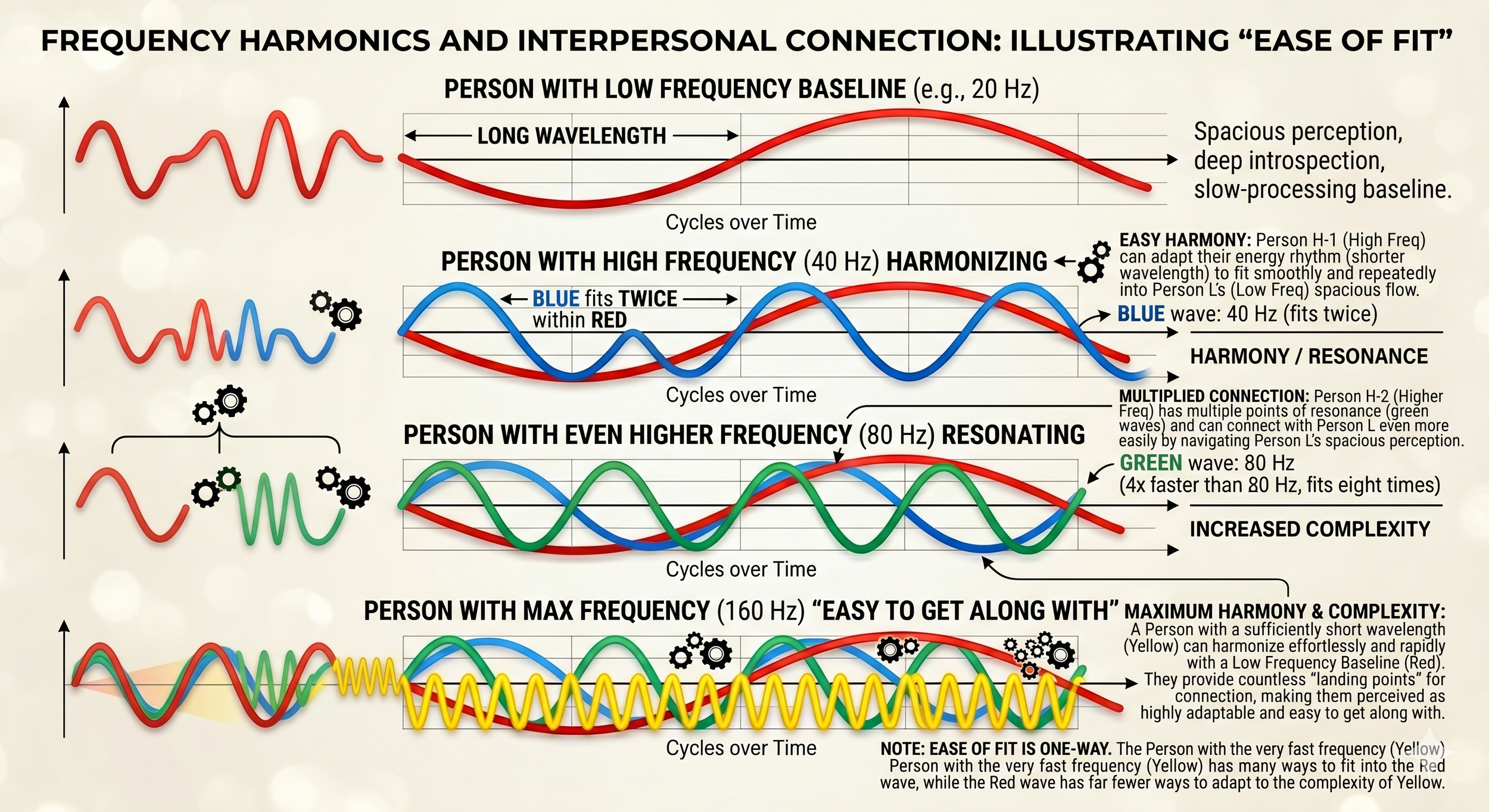
Visualizing interpersonal resonance: How shorter, higher-frequency wavelengths easily fit into and harmonize with a spacious, lower-frequency baseline.
Following this principle, if we are truly “raising our frequency,” we will notice certain definitive outcomes within our lives:
We will get along with more people. Others will naturally describe us as “easy to talk to,” “easy to like,” and “easy to get along with.”
We judge others less frequently. The number of people we dislike, or who feel completely foreign or different from us, decreases. It becomes easier to see things from other people’s perspectives and to accept them without judgment.
We are less easily agitated. Our emotions become smoother, more subtle, and we find ourselves upset less frequently. If a wave is vibrating extremely quickly, it becomes sharp and piercing. You notice how hard it is to drown out a high-frequency sound (like a fire alarm)—those sound waves are simply not as easily muffled by outside noise.
So, if you can understand this terminology and the descriptions above resonate with you, you can begin to ask yourself: What am I doing to raise my frequency? How can I practice getting along with others?
It’s okay to embrace the woo as long as it makes sense, and hopefully, this makes sense. Life is hard enough, and struggles happen every single day. If the one thing we do in this life is work on raising our frequency and getting along with others, we can hopefully make it through with a sense of internal peace, confidence, and purpose.
Want to raise your frequency? Shoot me a message and let’s talk about it.